Key Takeaways
- If your AC is not cooling properly, it may need refrigerant, but low refrigerant is not the only possible cause.
- A recharge adds the correct amount of refrigerant back into the system. A repair fixes the problem that caused the AC to stop working.
- If the AC gets cold after a recharge but turns warm again later, there may be a refrigerant leak.
- Compressor, cooling fan, condenser, electrical, and airflow problems can all feel like a refrigerant problem.
- I recommend diagnosing the system before adding refrigerant or replacing expensive parts.
- If the system is working properly, it should not need frequent refrigerant top-ups.
Does My Car AC Need a Recharge or a Repair?
Here’s the short answer: if your car AC is blowing warm air, it might need a recharge, but that does not mean a recharge is the actual repair.
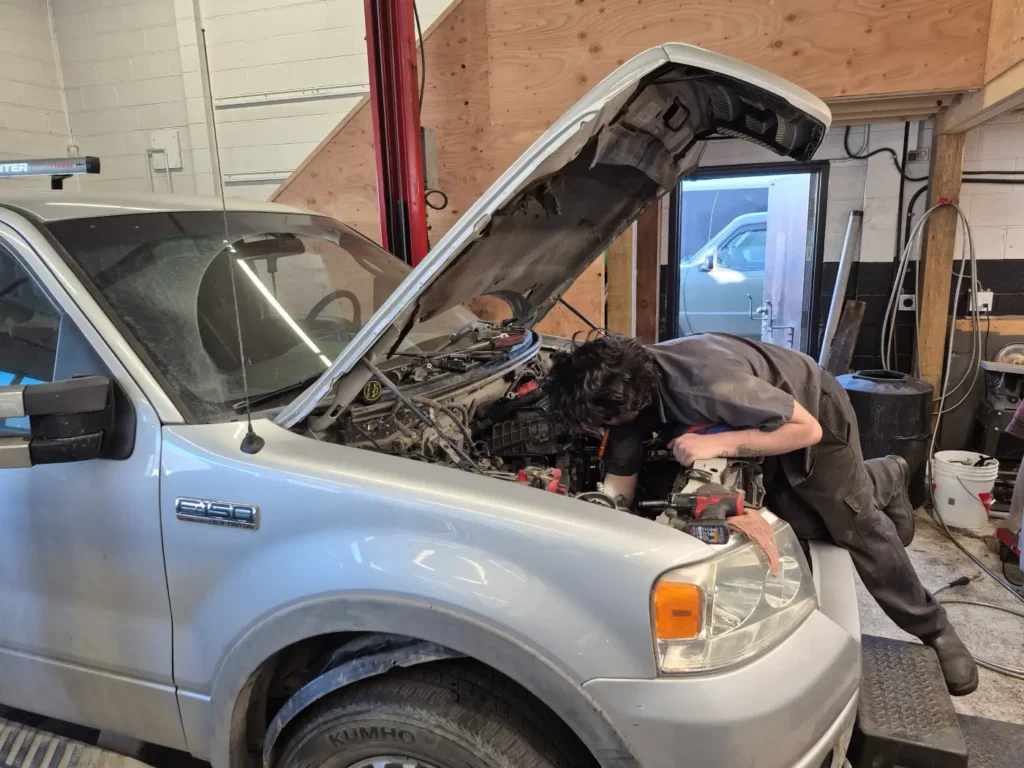
When a customer comes into Brock Auto Centre and tells me the AC is not as cold as it used to be, I don’t start by assuming it needs refrigerant.
I want to know why it stopped cooling.
If the refrigerant is low, where did it go? If the compressor isn’t running, is the compressor bad, or is an electrical problem stopping it from turning on?
That distinction matters.
A recharge may be part of the solution. But if there is a leak, a failed cooling fan, an electrical issue, or another bad component, adding refrigerant alone won’t fix the problem.
That’s why I always prefer to diagnose the system first.
If your AC is blowing warm air, you can also read our guide to 7 common reasons your car AC isn’t working.
And in a Kamloops summer, you notice pretty quickly when the AC isn’t doing its job. After a vehicle has been sitting in the sun all afternoon, warm air from the vents is hard to miss.
What Is a Car AC Recharge?
A recharge means restoring the correct amount of refrigerant in the air-conditioning system.
Refrigerant is the material that allows the AC system to move heat out of the cabin.
When the system is low, you may notice:
- The AC is cool but not cold
- It takes longer to cool the vehicle
- The air gets warmer on very hot days
- Cooling comes and goes
- The system worked better in the past
If testing shows the refrigerant level is low, adding the correct amount may be part of the service.
But here’s what I tell customers:
Refrigerant isn’t like engine oil or fuel. You shouldn’t assume it simply gets used up.
Your AC is designed as a closed system.
If it is low, I want to know whether there is a leak.
What Is an AC Repair?
An AC repair means fixing the actual cause of the problem.
That can mean very different things depending on what failed.
For example, a repair might involve:
- Fixing a refrigerant leak
- Replacing a damaged seal or O-ring
- Repairing or replacing a condenser
- Repairing a cooling fan problem
- Fixing wiring or a bad relay
- Replacing a failed sensor
- Repairing a blower motor problem
- Replacing a compressor if testing confirms it has failed
That is why “AC repair” and “AC recharge” are not the same thing.
A recharge deals with the refrigerant level.
A repair deals with why the system isn’t working properly.
How Do I Know If My Car Just Needs a Recharge?
You usually cannot confirm that from symptoms alone.
That’s important.
Customers sometimes tell me:
“It isn’t cold anymore, so it must need a recharge.”
Maybe. But warm air can also come from several other problems.
There are a few signs that can point us toward a low refrigerant level:
- The AC slowly became less cold over time
- The air is still somewhat cool
- The system cools better in mild weather than very hot weather
- Refrigerant pressure testing shows the system is low
But I still want to check the rest of the system before deciding that adding refrigerant is all it needs.
Why Would My Car Be Low on Refrigerant?
Usually, this is the bigger question.
If the system is low, there may be a leak somewhere.
Common places include:
- Hoses
- Seals
- O-rings
- Connections
- The condenser
- Compressor seals
- Other AC components
Some leaks are easy to spot.
Others can be small and take proper testing to find.
Environment and Climate Change Canada’s guidance for mobile air-conditioning systems specifically includes leak testing as part of servicing these systems. It also describes methods such as fluorescent dye and other proven leak-detection technology.
If the AC is low, I’d rather find out where the refrigerant went than keep adding more and hoping the problem goes away.
What Are the Signs I Need an AC Repair Instead of Just a Recharge?
This is where the pattern of the problem helps.
I’d be more suspicious of an actual fault if:
- The AC was recently recharged and is warm again
- Cooling suddenly stopped instead of slowly getting weaker
- You hear noises when the AC turns on
- The compressor does not operate
- The AC works while driving but gets warm when stopped
- The cooling fan is not working
- The system has an electrical fault
- Airflow from the vents is weak
- A leak has already been confirmed
When I hear one of those symptoms, I don’t want to keep adding refrigerant until we understand what the rest of the system is doing.
Why Did My AC Get Cold After a Recharge and Then Turn Warm Again?
This is one of the biggest clues that the system may have another problem.
A customer might say:
“I had it recharged last summer. It was cold for a while, but now it’s warm again.”
When I hear that, I don’t automatically recommend another recharge.
I want to know:
Where did the refrigerant go?
If the system was filled correctly and then became low again, a leak becomes a real possibility.
Adding refrigerant may make the AC cold again temporarily, but it doesn’t repair a leaking component.
That’s why repeated recharging without diagnosis can turn into a cycle.
Cold for a while. Warm again. Recharge again.
I’d rather stop that cycle and find the cause.
How Long Should an AC Recharge Last?
There is no honest answer like “one year” or “three years” that applies to every vehicle.
If the system is sealed and working properly, refrigerant should not need constant topping up.
So if your AC becomes low again shortly after service, I would not treat that as normal maintenance.
That is something worth investigating.
The time between services matters less to me than why the refrigerant level changed.
Could the Compressor Be the Problem?
Yes, but I would not jump straight to that conclusion.
The compressor is an important part of the AC system. It helps move refrigerant so heat can be removed from the cabin.
Possible compressor-related symptoms include:
- No cooling
- Cooling that comes and goes
- Unusual noise when the AC is on
- Compressor not operating when expected
But here’s the problem:
Low refrigerant, electrical faults, bad sensors, wiring problems, and other issues can create similar symptoms.
Before I recommend an expensive compressor, I want to know that the compressor itself is actually bad.
That is an important part of how we approach Auto Electrical & AC Repair in Kamloops.
Why Does My AC Work While Driving but Get Warm When I Stop?
This is another useful clue.
When you’re driving, outside air naturally moves through the front of the vehicle and across the AC condenser.
When you stop at a red light, the vehicle relies more heavily on electric cooling fans.
So when a customer tells me:
“It’s cold on the highway but warm in traffic,”
one of the areas I want to check is condenser airflow and fan operation.
Possible causes can include:
- Cooling fan failure
- Fan relay or wiring problem
- Blocked condenser
- Low refrigerant
- Other pressure or control issues
Again, I would test the system before deciding which part needs attention.
Could an Electrical Problem Make the AC Blow Warm?
Absolutely.
Modern automotive AC systems rely heavily on electrical components.
Depending on the vehicle, that can include:
- Fuses
- Relays
- Pressure sensors
- Temperature sensors
- Wiring
- Switches
- Control modules
- Fan circuits
A compressor can be perfectly fine but still not operate if the electrical system is not telling it to.
This is why automotive AC and electrical diagnosis often overlap.
Sometimes the refrigerant side of the system is not the problem at all.
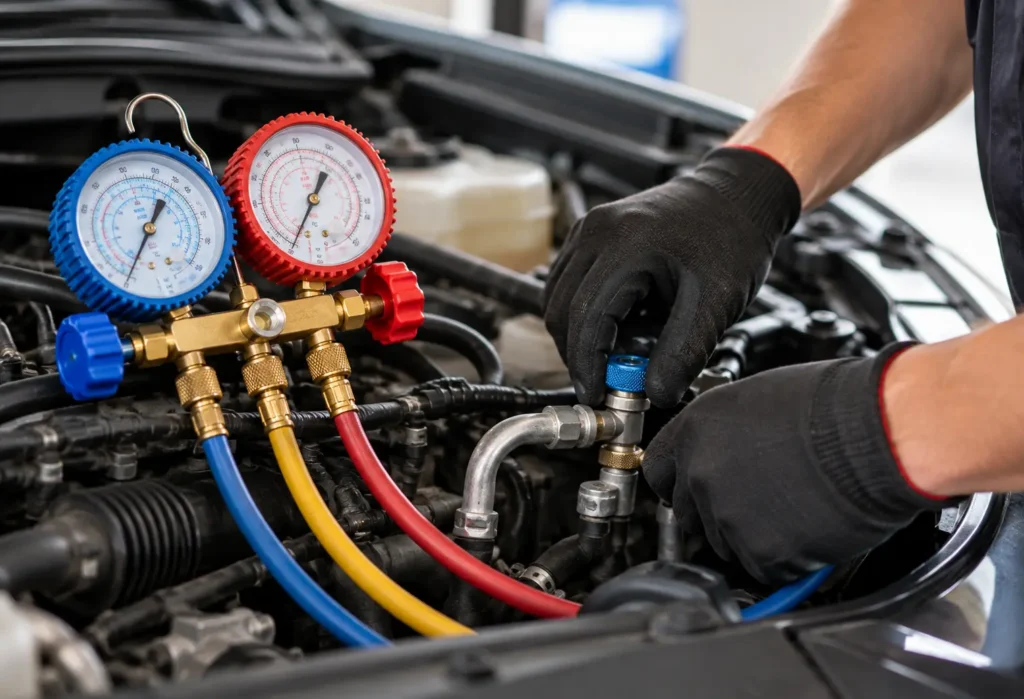
What Do We Check Before Recharging a Car AC System?
There isn’t one test that tells us everything.
What I check depends on what the customer tells me and what the vehicle is doing.
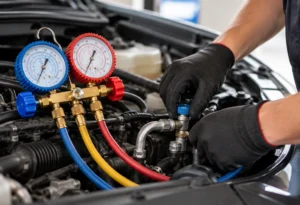
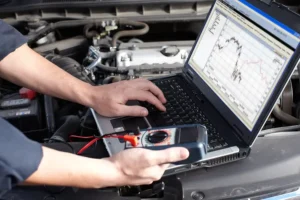
An AC diagnosis may include:
- Vent temperature
- System pressures
- Refrigerant level
- Signs of leaks
- Compressor operation
- Condenser condition
- Cooling fan operation
- Fuses and relays
- Wiring and electrical controls
- Blower operation
- Sensors and AC controls
The goal isn’t to create a long repair list.
The goal is to answer one question:
What is actually causing the AC problem?
Once we know that, we can explain what needs attention and what doesn’t.
That’s a much better approach than throwing parts at the vehicle.

Can I Recharge My Car AC Myself?
You can find DIY AC products in stores, but I tell customers to be careful.
Different vehicles can use different refrigerants, and the system needs the correct type and amount.
There is also the bigger question:
Why did the system become low in the first place?
A DIY recharge can add refrigerant, but it doesn’t automatically tell you whether you have:
- A leak
- A compressor problem
- An electrical fault
- A cooling fan issue
- Another AC system failure
Environment and Climate Change Canada also notes that the removal of halocarbon refrigerants generally requires a qualified technician under applicable federal and provincial or territorial regulations.
So if your AC has stopped cooling, I’d rather diagnose it properly than start adding refrigerant without knowing what’s happening.
Does Using Car AC Increase Fuel Consumption?
Yes.
The AC system needs energy to operate.
Natural Resources Canada says using vehicle air conditioning increases fuel consumption because of the additional load on the engine. The actual impact depends on things such as outdoor temperature, vehicle size, and operating conditions.
But my advice is practical:
Don’t sit in a hot Kamloops car just to save a little fuel.
Use the AC when you need it. Just make sure the system is working properly.
How Often Should I Recharge My Car AC?
I don’t recommend putting every vehicle on the same recharge schedule.
Your AC system is not something I would automatically recharge every year just because a certain amount of time has passed.
Instead, pay attention to how it performs.
Have the system checked if:
- It is no longer as cold as before
- Cooling comes and goes
- The AC blows warm air
- It was recently recharged and is warm again
- You hear unusual noises
- The AC behaves differently at idle versus highway speed
Your vehicle’s actual condition matters more than a generic calendar interval.
If the vehicle is also due for other service, you can review our scheduled maintenance services.
How Much Does a Car AC Recharge Cost in Kamloops?
The cost can vary because not every vehicle or AC problem is the same.
Price can depend on:
- Refrigerant type
- How much refrigerant is needed
- Diagnostic time
- Whether leak testing is required
- Whether parts need repair or replacement
- Vehicle design and access
That’s why I would be careful with a very cheap “AC recharge” price that doesn’t include any real diagnosis.
If the system has a leak, knowing that before paying to refill it can save you from paying twice.
At Brock Auto Centre, the goal is to tell you what we find before recommending the next step.
Do I Need a Recharge or Repair? Here’s the Simple Rule
If your AC isn’t cold, don’t start with:
“How much is a recharge?”
Start with:
“Why isn’t my AC cooling?”
That one change in the question can save you a lot of guessing.
If the system is simply low and everything else checks out, a recharge may be appropriate.
If there is a leak, bad fan, compressor problem, sensor issue, or electrical fault, then that problem needs to be dealt with.
That’s the difference between adding refrigerant and fixing the AC system.
Need Car AC Recharge or Repair in Kamloops?
If your AC isn’t cooling properly, we can help figure out why.
At Brock Auto Centre, I’d rather test the system, explain what we find, and recommend only what the vehicle actually needs.
Learn more about our Auto Electrical & AC Repair in Kamloops, or contact Brock Auto Centre to book an appointment.
We’ll give you a straight answer about whether your AC needs a recharge, a repair, or something else entirely.
About the Author
Steve is a co-owner of Brock Auto Centre at 1128 Tranquille Rd in Kamloops, BC. With years of hands-on automotive experience, Steve focuses on helping Kamloops drivers understand what is happening with their vehicles and make informed maintenance and repair decisions.