Key Takeaways
- If your car AC is blowing warm air, low refrigerant is only one possible cause.
- Refrigerant leaks, compressor problems, cooling fans, electrical faults, and airflow issues can all affect AC performance.
- If your AC gets cold after a recharge but turns warm again later, there may be a leak.
- AC that works while driving but gets warm when stopped can point to a condenser airflow or cooling-fan problem.
- Warm air does not automatically mean you need a new compressor.
- The first step should be finding the cause before replacing parts or adding refrigerant.
Why Is My Car AC Blowing Warm Air?
Here’s the short answer: if your car AC is blowing warm air, I usually start by looking at seven areas — refrigerant level, leaks, the compressor, condenser airflow, cooling fans, electrical components, and airflow inside the cabin.
A lot of customers assume warm air means the AC just needs a recharge. Sometimes it does. But I don’t like guessing.
If the refrigerant is low, I want to know why it became low. If the compressor isn’t running, I want to know whether the compressor itself has failed or whether an electrical problem is stopping it from working.
That’s how we approach AC problems at Brock Auto Centre. Find the cause first, then talk about what actually needs to be repaired.
And in a Kamloops summer, you notice an AC problem quickly. After your vehicle has been sitting in the sun all afternoon, warm air from the vents is hard to ignore.
1. Your Car May Be Low on Refrigerant
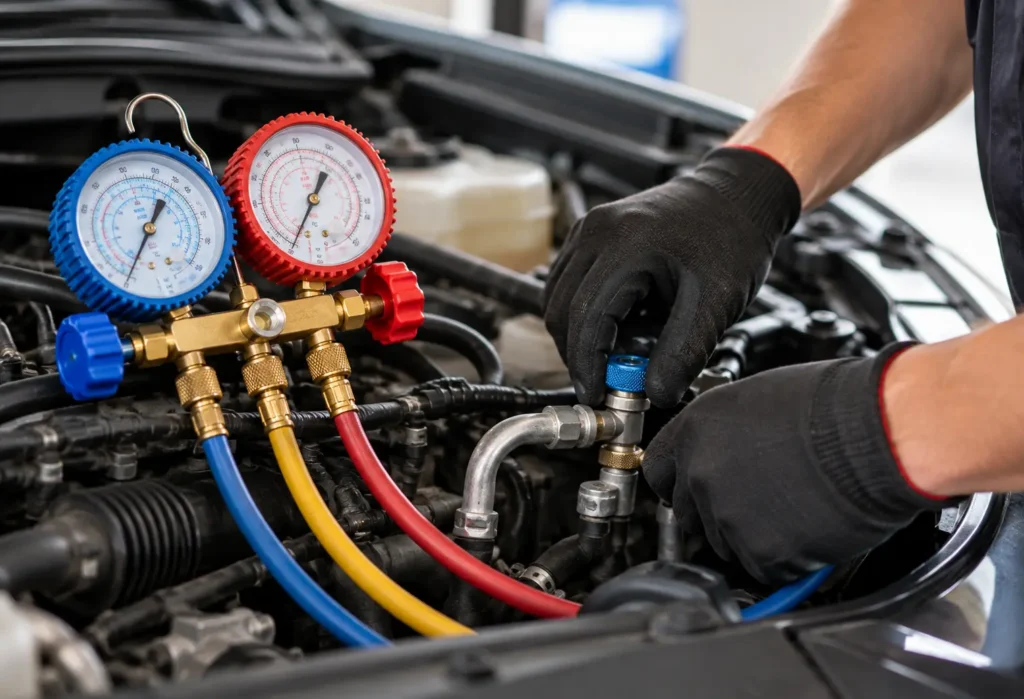
Refrigerant is what helps the AC system move heat out of your vehicle.
When the refrigerant level gets too low, the AC may still run, but it may not cool very well.
Customers often describe it to me like this:
- “It’s cool, but not cold.”
- “It takes forever to cool down.”
- “It worked last summer.”
- “It was cold after a recharge, but now it’s warm again.”
Those are useful clues.
But when I find a system that is low on refrigerant, I don’t want to stop there.
The next question is:
Why is it low?
Your AC is designed as a closed system. Refrigerant should not simply disappear because the vehicle reached a certain mileage.
If it is low, there may be a leak.
2. There May Be a Refrigerant Leak
This is one of the first things I think about when a vehicle keeps losing cooling performance.
A leak can happen in several places, including:
- Hoses
- Seals and O-rings
- Connections
- The condenser
- The compressor
- Other AC components
Some leaks are obvious. Others are small enough that they take proper testing to find.
That’s why I’m cautious about simply adding refrigerant and sending the vehicle out the door.
If it gets cold today but comes back warm again in a few weeks or months, we haven’t really solved the problem.
Environment and Climate Change Canada’s guidance for mobile air-conditioning systems includes leak testing as part of proper refrigerant service and discusses methods used to identify leaks.
The goal is simple: find where the refrigerant is going before deciding what the vehicle needs.
3. The AC Compressor May Have a Problem
The compressor is an important part of the AC system. It helps circulate refrigerant so the system can move heat out of the cabin.
If it isn’t working properly, you may notice:
- Warm air from the vents
- Cooling that comes and goes
- Unusual noises when the AC is on
- No cooling at all
But this is where I tell customers not to jump to conclusions.
Warm air does not automatically mean you need a compressor.
I’ve seen electrical problems, low refrigerant, control issues, and other faults create very similar symptoms.
A compressor can be an expensive part. Before recommending one, I want to know that it’s actually the problem.
That’s better for the customer, and it’s the right way to diagnose the vehicle.
4. The Condenser May Not Be Getting Enough Air
The condenser normally sits near the front of the vehicle.
Its job is to release heat from the AC system.
If it can’t get rid of that heat properly, the AC may start blowing warmer air.
Things I would look at include:
- Dirt or debris blocking the condenser
- Physical damage
- Refrigerant problems
- Cooling fan operation
One question I often ask is:
Does your AC work better when you’re driving than when you’re stopped?
That detail matters.
When the vehicle is moving, outside air naturally flows through the front of the car and across the condenser.
When you’re stopped at a traffic light, the vehicle relies much more on its cooling fans.
If the AC gets warm mainly when the car is sitting still, that gives us somewhere useful to start looking.
5. A Cooling Fan May Not Be Working
Cooling fans help pull air through the condenser when the vehicle isn’t moving fast enough to create that airflow on its own.
If a fan isn’t working correctly, a customer might tell me:
“The AC is cold on the highway, but it gets warm when I stop.”
That doesn’t prove the fan is bad, but it’s a good clue.
The actual problem could be:
- The fan motor
- A fuse
- A relay
- Wiring
- A sensor
- A control problem
So again, I don’t want to replace a fan just because the symptom sounds right.
We test what the system is doing first.
6. It Could Be an Electrical Problem
Modern AC systems have a lot of electrical parts behind the scenes.
Depending on the vehicle, the system may rely on:
- Fuses
- Relays
- Wiring
- Pressure sensors
- Temperature sensors
- Switches
- Control modules
An electrical fault can make the AC:
- Stop working suddenly
- Work only sometimes
- Blow warm air
- Fail to turn the compressor on
- Behave differently from one drive to another
This is one reason AC problems can be harder to diagnose than people expect.
Sometimes the refrigerant side of the system is fine, but an electrical issue is preventing the AC from operating properly.
At Brock Auto Centre, our Auto Electrical & AC Repair in Kamloops service covers both sides of the problem.
That matters because I’d rather trace the actual fault than replace a mechanical part that wasn’t bad in the first place.
7. The Problem May Be Airflow Inside the Car
Sometimes the AC system is producing cold air, but you aren’t getting enough of that air through the vents.
That can make it feel like the AC isn’t working.
Possible causes include:
- A dirty cabin air filter
- A blower motor problem
- A blower control issue
- A stuck air door or actuator
- Blocked vents
Here’s one easy check I tell customers to try.
Turn the fan up.
If the air feels cold but barely comes out of the vents, I start thinking more about an airflow problem.
If there is lots of air coming out but it is warm, I start looking more closely at the cooling side of the AC system.
It’s a small detail, but it can help point us in the right direction.
Does My Car AC Need a Recharge or a Repair?
This is probably one of the most common AC questions I hear.
The answer is:
It depends on why the system stopped cooling.
If the refrigerant level is low, adding the correct amount of refrigerant may be part of the service.
But if I find that the system is low, I still want to understand why.
If there’s a leak, adding refrigerant doesn’t repair that leak.
That’s why I think of an AC recharge as a service step, not a diagnosis.
The diagnosis comes first.
Why Is My Car AC Cold While Driving but Warm When Stopped?
When a customer tells me this, it immediately gives me useful information.
I would want to look at things such as:
- Cooling fan operation
- Condenser airflow
- Refrigerant pressures
- Refrigerant level
- AC controls
When you’re driving, air is moving through the front of the vehicle.
When you stop, the fans have to take over much of that job.
If something in that airflow system isn’t working properly, you may notice the difference most when you’re sitting in traffic.
That can be especially obvious on a hot Kamloops afternoon.
Why Does My Car AC Start Cold and Then Turn Warm?
This is another symptom we hear fairly often.
The AC works when you first start driving. Then, after a while, the air becomes warm.
There are several possible reasons:
- Low refrigerant
- A refrigerant leak
- Compressor problems
- Electrical faults
- Sensor issues
- Airflow problems
When someone brings me a vehicle with this complaint, I usually ask a few simple questions:
How long does it stay cold?
Does it happen only when you stop?
Does it happen more often when it’s very hot outside?
If you turn the AC off and back on, does it start cooling again?
Those answers help us understand the pattern before we start testing.
What Happens During an Auto Air Conditioning Service?
There isn’t one single AC test that tells us everything.
What I check depends on what the vehicle is doing.
An AC diagnosis may involve:
- Checking vent temperature
- Checking system pressures
- Looking for refrigerant leaks
- Checking compressor operation
- Inspecting the condenser
- Checking cooling fans
- Testing electrical circuits
- Checking fuses and relays
- Checking blower operation
- Testing AC controls and sensors
The important part is the order:
Diagnose first. Repair second.
I don’t want to start replacing parts until we understand what caused the problem.
If a component is working properly, there’s no reason to replace it.
Can I Recharge My Car AC Myself?
You can find DIY AC products in stores, but I’d be careful with them.
Different vehicles use different refrigerants, and the system needs the correct type and amount.
More importantly, if your AC is low because it has a leak, adding more refrigerant doesn’t tell you where that leak is.
My advice is simple:
If the AC stopped cooling, figure out why before adding things to the system.
Does Using AC Use More Fuel?
Yes, it can.
Your AC system needs energy to operate, so running it puts an extra load on the vehicle.
Natural Resources Canada notes that air conditioning can increase fuel consumption and also recommends using the recirculation setting when appropriate because the system can cool air already inside the vehicle instead of constantly cooling hotter outside air.
But I wouldn’t tell someone to suffer through a Kamloops summer just to save a little fuel.
Use your AC when you need it. The important thing is that the system is working properly and efficiently.
How Often Should My Car AC Be Serviced?
I don’t use one blanket rule for every vehicle.
Your AC doesn’t automatically need a recharge every year just because another vehicle does.
Instead, I tell customers to pay attention to changes.
Have the system checked if:
- The AC isn’t as cold as it used to be
- It starts blowing warm air
- Cooling comes and goes
- Airflow becomes weak
- You hear a new noise when the AC turns on
- The system was recently serviced and has already stopped cooling again
Your vehicle’s condition and manufacturer recommendations matter more than a generic schedule.
If you’re also due for other regular service, you can learn more about our scheduled maintenance services.
Can I Keep Driving If My AC Is Blowing Warm Air?
Usually, a lack of cold cabin air by itself doesn’t mean the vehicle has to stop driving.
But I would pay attention to what else is happening.
I’d want the vehicle checked sooner if you also notice:
- Engine overheating
- Strange noises under the hood
- A burning smell
- An electrical smell
- Warning lights
- Cooling fans not working
- Other changes in how the vehicle runs
And AC isn’t only about keeping you comfortable.
The system also helps remove moisture from cabin air when you’re trying to clear fog from the windows.
Car AC Blowing Warm Air in Kamloops? Start With the Cause
If there’s one thing I want you to take away from this article, it’s this:
Warm air is a symptom. It isn’t the diagnosis.
Maybe the refrigerant is low.
Maybe there’s a leak.
Maybe the compressor isn’t operating.
Maybe the condenser isn’t getting enough airflow.
Or maybe an electrical problem is stopping a perfectly good component from working.
That’s why we test before we replace.
At Brock Auto Centre, I’d rather explain exactly what we found and tell you what actually needs attention than start changing parts based on a guess.
If your car AC is blowing warm air, you can learn more about our Auto Electrical & AC Repair in Kamloops or contact Brock Auto Centre to book an appointment.
We’ll take a look, explain what’s going on, and help you decide what makes sense for your vehicle.
About the Author
Steve is a co-owner of Brock Auto Centre at 1128 Tranquille Rd in Kamloops, BC. With years of hands-on automotive experience, Steve focuses on helping Kamloops drivers understand what is happening with their vehicles and make informed maintenance and repair decisions.